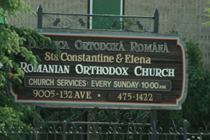
SAINTS CONSTANTIN AND ELENA CHURCH OF EDMONTON
It is impossible to talk about our parish without traveling down the memory lane to the very beginning. And what a great beginning do we, the Romanian Orthodox of central Alberta have! What a wonderful and inspiring story do we have to share with the present and future generations! It is the story of a resilient and God-fearing group of Romanians who came from the Bucovinian Boian (Romania) over 100 years ago (1898) and established the Albertan Boian, 100 km North-East of Edmonton.
About the Romanian pioneers we have written extensively in the last few years, although one can never say enough about their steadfast faith in God, hard work, courage and determination. These are the spiritual qualities (values) that sustained them in difficult times and which they passed on to their descendants. Speaking of descendants, it is interesting to note that 50 years after the arrival of the first Romanian pioneers to Alberta, their descendants established Saints Constantine and Elena Romanian Orthodox parish in Edmonton in 1948. It took 24 more years before the children and the grandchildren of the Romanian pioneers, living in Edmonton, gathered for the first time in their church to celebrate the Divine Liturgy (1972).
Since 1948 until 1972, they held religious services in private homes, in chapels at funeral homes and later on in the main hall, which is now part of the Romanian Centre. The reason it took this long is because they were neither oil tycoons, nor rich landowners but modest workers who made great financial sacrifices in order to lay a solid foundation for this great legacy we all take so much pride in today.
Just as the Romanian pioneers before them, they too had to contend with adversities of all kinds but once again their faith in God and hard work proved superior to life’s challenges.
Emphasizing the transforming power of our Savior’s Cross, an Orthodox hymn dedicated to this instrument of salvation says: “O Lord, great is the power of Thy Cross… for it turned fishermen into apostles and pagans into martyrs…” The same can be said about the founders of our parish and church: A small group of people with limited financial possibilities but great faith and a clear vision for the future, under the spiritual guidance of their young parish priest, the V. Rev. Fr. Mircea Panciuk (who came to Edmonton in 1969), became Church founders, enriching the landscape of this city with one more Orthodox House of Salvation.
On Sunday morning, May 21, 1972, the hard-working parishioners of Saints Constan-tine and Elena of Edmonton were making their way towards the heart and soul of their community to take part in the consecration of their Church by His Grace Bishop Victorin. This was a happy and mighty proud event for the men and women, young and old, who proved that the Orthodox faith was burning in their hearts and souls just as much as it did in the hearts and souls of their ancestors.Their great financial sacrifices and countless hours of volunteer work had materialized into this beautiful church where they and generations upon generations after them would come to participate in the sacramental life of the Church, asserting their vocation as liturgical beings.
Today we are fortunate enough to have among us some of the founding members of both the parish and the church. Even now, after so many years, one can easily notice the emotion in their voices as they reminisce about those moments, which have been forever etched in the history of the Romanian community of Edmonton.
Over the years, there were other milestones in the life of our parish. Some 20 years ago an addition was built, which constitutes the stage for the main Hall, with the office area above it, and the spacious entrance to the church (the foyer), guarded by the bell tower.
In 1989, the new parish priest, Fr. George Bazgan, came from Los Angeles to Edmonton, having the difficult task of building upon the solid foundation laid by the founders of our church and by the Boian pioneers.
În 2001, Florin Vlad, an iconographer and church artist from Romania, newly established in Edmonton, was awarded the contract to paint the entire ceiling of the church in the Byzantine style, the acrylic technique. One year later, on May 19, 2002, on the occasion of the 30th Church Anniversary, His Eminence Metropolitan Joseph of Paris, Locum Tenens of our Archdiocese (at the time), in an atmosphere of joy and jubilation, blessed the newly painted church ceiling .
The Byzantine painting adds not only artistic value to the church but also links the visible and the invisible worlds together in this cosmic offering of praise and adoration to our loving God who is the creator of the whole universe.
One year later, the entire Altar was also painted by the same iconographer.
This beautiful and delicate Byzantine “tapestry” transcends time and space and provides comfort to the minds and souls of those who cross the threshold of our church with the sincere desire to renew or strengthen their communion with God and pre-taste, here and now, His heavenly and eternal kingdom. Those who have found in their hearts the goodness and the spirit of sacrifice to contribute with the fruit of their labor towards this beautiful project have become co-founders of this church, contributing thus to the continuation of the dream and vision of the forever-remembered founders of the parish in 1948 and of the church building in 1972.
In 2004, the church received a much needed transformation through the creation of the three archways between the vestibule and the church itself, which reveals the beauty of the hand-carved iconostasis and the Byzantine painting as soon as one opens the door. This area was also adorned with the beautiful Byzantine painting in 2005.
Today, Canadian-born Romanians and their families, together with many families of new immigrants from Romania, participate every Sunday in the Eucharistic celebration as well as various social and cultural events. We have a Sunday School program and a Romanian Orthodox Youth Association (ROYA).
As we continue to be inspired by the faith and vision of our ancestors, in accordance with the spirit and practice of the Orthodox Church, it is fitting to close with two liturgical petitions, which are an indication of the Church’s eternal gratitude for those who made the promotion of the Lord’s Gospel a top priority of their lives: “O Lord, sanctify those who love the beauty of Thy House” and “May the Lord God remember the founders of this holy church in His Kingdom. Amen.”
Heartfelt thanks and deep apprreciation to our dedicated members and supporters!
May God continue to shed His Grace upon us, His humble servants!
Fr. George Bazgan
________________________
THE ROMANIAN ORTHODOX ARCHDIOCESE
IN THE AMERICAS
The Romanian Orthodox Archdiocese in America and Canada was established as an Episcopate subsequent to the approval of the Holy Synod of the Romanian Orthodox Church in 1935.
The preliminary steps worth noting are: At the Church Congress, held in Detroit, Michigan, on April 25-28, 1929, the priests and representatives of the Romanian Orthodox parishes in the USA and Canada agreed to organize a Missionary Episcopate under the canonical jurisdiction of the Holy Synod of the Romanian Orthodox Church. The decision was presented to Patriarch Miron (Cristea) of the Romanian Orthodox Church, who gave his approval by the decree no. 10219, dated November the 1st, 1930. The Patriarch entrusted an interim commission with the organization of the Episcopate until the election of a suffragan bishop by the Holy Synod of the Romanian Orthodox Church.
At the Church Congress held on October 30, 1932, the first Statutes and By-Laws of the Episcopate were formulated. They were ratified by the Holy Synod on June 15, 1933 and officially promulgated on May 8, 1934.
The real date for the establishment of a diocese, according to the cannonical rules of the Orthodox Church, however, must be considered as the date of the canonical election, consecration and installation of the first bishop by the Holy Synod of the Orthodox Church.
The first bishop of the Romanian Orthodox Missionary Episcopate in America and Canada was the late bishop Policarp Moruºca. Bishop Policarp was born on March 20, 1883 in Cristeºti, Alba. In 1925 he entered the monastic life and was appointed Superior of the Hodos-Bodrog monastery in the region of Arad. Upon the recommendation of a delegation of the Romanian Orthodox parishes in America and Canada, the Holy Synod of the Romanian Orthodox Church, in its assembley of January 26, 1935, approved his election to the dignity of Bishop. He was consecrated Bishop on March 24, 1935, and on March 25, the Feast of Annunciation, he was invested by Patriarch Miron of Romania as the canonical Bishop of the Romanian parishes in America and Canada. He arrived in Detroit on July 3, 1935 and was enthroned on July 4, 1935, in St. George's Romanian Orthodox Cathedral of Detroit, Michigan as Bishop of the Romanian Orthodox Missionary Episcopate in America and Canada. The late Bishop Policarp went back to Romania in 1939 and never returned to the United States of America.
In his absence, he left the spiritual care of the diocese to the Greek Orthodox Archdiocese of North America, and the administration to the Diocesan Council headed by the late Archpriest Simion Mihaltean, as Vicar of the Episcopate.
In 1950, the Holy Synod of the Romanian Orthodox Church, by its decision of November 4, 1950, and in accordance with Art. 6 of the Statutes of the Episcopate and the Canons of the Orthodox Church, elevated the V. Rev. Fr. Andrei Moldovanu, then priest of the Presentation od our Lord, Romanian Orthodox Church of Akron, Ohio, to the dignity of Bishop. He entered the monastic order on Nov. 5, 1950, in the Neamt Monastery. He was consecrated Bishop in the Holy Trinity cathedral of Sibiu, Romania, on November 12, 1950 by Metropolitan Nicolae Balan of Sibiu, Bishop Andrei Magieru of Arad, Bishop Nicolae Colan of Cluj, Bishop Teoctist Botoºãneanu and Bishop Antim Targovisteanul, Patriarchal Vicars.
He was invested by Patriarch Justinian of the Romanian Orthodox Church, in the Patriarchal Cathedral of Bucharest, on November 19, 1950 and was appointed successor to Bishop Policarp, as spiritual leader of the Romanian Orthodox Missionary Episcopate in America and Canada.
Upon his arrival in the USA, some priests and lay representatives of the parishes were disatisfied with his election and held a special Congress in Chicago, in 1951. They broke canonical ties of their parishes with the Holy Synod of the Romanian Orthodox Church and organized an independent episcopate without any relationship with any Synod. They adopted a new name for their diocese as the Romanian Orthodox Episcopate of America and elected a layman theologian Viorel Trifa as Vicar Bishop of the Episcopate. He was ordained by three bishops of the Ukrainian Orthodox Church of the USA, as bishop Valerian D. Trifa. Since the ordaining Ukrainian bishops were not themselves canocally ordained, bishop Valerian's ordination was itself noncononical and, concequently, the Holy Sacraments celebrated by him during this time (nine years) were not valid. (A bishop must be ordained by three or more canonically ordained bishops in order for that bishop to have Apostolic succession).
In 1960, bishop Valerian and his Episcopate joined the Russian Orthodox Greek Catholic Metropolia, later on called the Orthodox Church of America (OCA) and headed by the Russian Metropolitan Theodosius. Bishop Valerian was reordained (this time canonically) as bishop with the title "Bishop of Detroit and Michigan." In 1970, Bishop Valerian was elevated to the rank of Archbishop. This Romanian Episcopate is now headed by Archbishop Nathaniel and continues to be under the jurisdiction of OCA.
Following the death of Bishop Andrei Moldovanu, the Romanian Orthodox Missionary Episcopate in America and Canada held a special Congress, on April 23, 1966 in Detroit, Michigan and elected the Rt. Rev. Archmandrite Victorin (Ursache) as Bishop of its Diocese. The election was approved on June 7, 1966 by the Holy Synod of the Romanian Orthodox Church and, with the blessing and approval of the Ecumenical Patriarch Athenagoras of Constantinople and of Patriarch Justinian of Romania, he was consecrated Bishop on August 7, 1966 at St. George's Romanian Orthodox Cathedral of Windsor, Ontarioa, by the Most Rev. Archbishop Iakovos, Primate of the Greek Orthodox Church of North and South America, the late Archbishop Epiphanios of Philadelphia (Jordan) and Archbishop Aristovoulos of Kyriakoupolis, both of the Orthodox Patriarchate of Jerusalem. The official enthronment of Bishop Victorin took place in the Holy Trinity Romanian Orthodox Cathedral of Detroit, Michigan, on August 21, 1966. His Eminence Metropolitan Nicolae Corneanu of Banat, as representative of the Romanian Orthodox Church officiated.
The Holy Synod of the Romanian Orthodox Church, on June 11, 1973, elevated Bishop Victorin to the rank of Archbishop. Consequently, the Annual Congress of the Romanian Orthodox Missionary Episcopate in America and Canada, held on July 21, 1973 in Edmonton-Boian, Alberta, decided to change the title of the Diocese from "Episcopate" to "Archdiocese." The decision was approved by the Holy Synod of the Romanian Orthodox Church on December 12, 1974, renewing at the same time the status of the Diocese as an "Autonomous Archdiocese."
Following the death of Archbishop Victorin (July 16, 2001), the Electoral Congress of the Archdiocese, held at Holy Trinity Romanian Orthodox Church of Troy, Michigan on March 9, 2002, elected the V. Rev. Fr. Dr. Nicolae Condrea as the new Archbishop. The decission was approved by the Holy Synod of the Romanian Orthodox Church. At the conclusion of the 71st Annual Congress of our Archdiocese, on July 14, 2002, in St. John the Baptist Romanian Orthodox Church of Montreal, Quebec, Fr. Nicolae Condrea was ordained and installed as Archbishop Nicolae by His Beatitude Patriarch Teoctist of Romania, accompanied by a large number of Orthodox hierarchs from Romania, Western Europe and North America.
In 2002, the headquarters of the Romanian Orthodox Archdiocese in America and Canada were moved to Chicago, Illinois. The website of the Archdiocese can be accessed at www.romarch.org
The Archbishop is a member of the Holy Synod of the Romanian Orthodox Church, with deliberative vote in all matters concerning his jurisdiction.
The administration and legal decisions are made by the Church Congress, approved by the Archbishop and carried out by the Archdiocesan Council. The Church Congress consists of the clergy of the Archdiocese and two lay dalegates from each parish under the canonical jurisdiction of the Archdiocese. On a local level, the Archbishop is in inter-communion with all the Orthodox Bishops of the Eastern Orthodoc Churches in America and Canada, through the Standing Conference of the Canonical Orthodox Bishops in the Americas (SCOBA), headed by the Archbishop of the Greek Orthodox Archdiocese of North and South America as Exarchas of the Ecumenical Patriarchate of Constantinople in America.
& & & & & & & & & & & & & & & & & &
EMINESCU IN EDMONTON
Eminescu – the pride of all Romanians everywhere
"We are the true Eminescu's contemporaries because we know more things about him than those who lived in his time" (Edgar Papu).
On the firmament of the Pantheon of the universal geniuses shines brightly, for over a century, the Morning Star of the Romanian poetry, Mihai Eminescu. In spite of the malicious commentaries/attacks made in recent times against the great poet by those who lack the qualities to otherwise make a name for themselves, the undoubting fact is that the literary legacy of the genius poet places him above all the venomous statements and reaffirms him as the greatest Romanian poet of all times.
Through his entire literary works, created during his short life (39 years), Eminescu attests the creative spirit of the Romanian people, its love for the ancestral land, and the richness of our national folklore. His works constitute a priceless legacy handed down to the nation he was born into, which he loved with all of his being. His writings are appreciated at a worldwide scale, being translated into an impressive number of languages, from the oldest ones (Greek and Armenian) to the most modern: English, French, German, Spanish, Italian, etc. Therefore, Eminescu became a universal poet, loved by all those whose entire being pulsates with the feelings of love for what is beautiful, regardless of their ethnic origin.
This sentiment of national pride, as well as the desire o make the great poet known to as many people as possible, constituted the basis for the efforts of the Romanian Diaspora from all over the world to honor his memory through a variety of cultural events or artistic representations, bringing him in their midst as a true national genius and symbol of the efforts for the national unity of the Romanian people. It is for this reason that Eminescu's bust or his representation in life size can be admired on the banks of Lake Leman in Switzerland, in Vienna, Paris, Rezina (Republic of Moldova), Comrat (the Gagauz territory), New York, Montreal, Windsor and now in Edmonton, Alberta, one of the ten provinces of Canada.
The idea of having Eminescu's monument erected in Edmonton is a few years old and the brainchild of professor and author Constantin Clisu, established with his family in Edmonton. In the beginning, the idea was mentioned casually to me and then, as time went by, it was embraced by many Romanians established in the city of Edmonton. I must confess that, although I liked the idea from the very beginning, I gave it a lot of thought, knowing that such a project required time, much effort and especially a great deal of money. About a year ago, professor Clisu showed me the graphic representation of the monument, which I fell in love with. Around the same time, I remember Mr. Clisu quoting to me one of Tudor Musatescu's sayings: "Father, the ideas are like the bedbugs that jump from person to person but only bite some of them!"
For awhile we explored the possibility of placing the monument on the grounds of the Provincial Parliament in Edmonton, Mr. Clisu telling me at some point that he had "picked" the appropriate spot. I, in turn, examined the area and identified the "ideal" place. Subsequent to our initial investigations, we realized that it would have been impossible to obtain the necessary approval for such a project. Then we concentrated on the most viable and practical solution, which now seems to be the obvious one, the placing of the monument in front of the Romanian Centre adjacent to Sts. Constantine and Elena Church.
We then proceeded to constitute a Committee, inviting the distinguished physician John Slanina, architect Kenneth Jason Forner and his wife Magdalena and Mr. George Chiosa to join us. I remember when I asked dr. Slanina to join this committee, he replied: "I'll contribute with a substantial sum of money for this project!" I then said to myself: "Here is a man who has the gift of reading other people's minds and who is very receptive to the… bedbugs' bites."
The plan evolved in a series of phases: having resolved the first and the easiest one – the idea, - we then moved to the next one, anticipated from the very beginning to be the most difficult, - the collection of funds for the physical implementation of this project. In the meantime, Mr. Clisu arranged with his good friend, Professor Gheorghe Alupoaei of Vaslui, Romania, to start working on Eminescu's bust in plaster. Last year, while vacationing in Romania, I sent Mr. Alupoaei $500 to cover the cost of the materials. All this was taking place even before we launched the first appeal for financial contribution to the Romanian people living in Edmonton. My confidence in their generosity, proven so many times in the past, was not disappointed. As a result, on the first Sunday I presented the project and made an appeal for donations we collected about $4,000 and the following Sunday we collected $5,000. In the meantime, Jason had completed the architectural documentation, dr. Slanina had bought and planted Eminescu's linden tree, Mr. George Chiosa had his team ready for the cement pouring of the main column, and Behrends Bronze Inc. of Edmonton was making progress in the execution in bronze of the bust, the book and the plaques. Everything was working very harmoniously, as if under the guide of an invisible force which had already become an intrinsic part of the organizing committee.
This year, on June 15, 2011, we celebrate 122 years since Mihai Eminescu's untimely passing into eternity. It is for us an emotional moment to mark this event by the unveiling of this monument, dedicated to the great poet, with an added feeling of patriotism and deep gratitude to all those who worked tirelessly and also to those who responded with the typical Romanian generosity in order to officially receive the Demiurge of the Romanian poetry in the midst of our community here in Edmonton.
We salute him and say to him in our harmonious Romanian language:
"WELCOME TO EDMONTON, THE MORNING STAR OF THE ROMANIAN POETRY!"
FR. GEORGE BAZGAN